
Your basket is currently empty!
Small Molecule Immune Modulation
Understand the Effects of Small Molecules on Immune Responses
with readily configured assays powered by ProImmune’s proven immunology assay platforms

Figure: Abacavir was found to cause severe inflammation in individuals with a specific HLA type.
The Renewed Promise of Small Molecules as Drugs
Small molecule drugs are chemically synthesized therapeutics, typically with a molecular weight of less than 1000 Daltons. Their small size allows them to penetrate cell membranes and, in some formulations, to cross the blood-brain barrier, offering unprecedented opportunities to target new proteins and treat challenging diseases. Small molecules accounted for 62% of the 2024 FDA approvals, with percentages trending to >70% in 2025. The resurgence in small molecule drug development can be attributed to a number of factors, including their ease of manufacturing, stability and variety of administration techniques. Advancements in technologies, such as machine learning and artificial intelligence, have also helped researchers to better design potent drugs with favourable safety profiles in an expedited manner.
Wanted and Unwanted Immune Responses are Inherent to Most Treatment Modalities
Despite these improvements unwanted immune response against the drug can occur through the small molecule’s mechanism of action, by directly modulating the immune system or by affecting key immune signalling pathways. For example, Abacavir, a nucleoside reverse transcriptase inhibitor used to treat HIV-1 infection, can form a complex with HLA-B*57:01, leading to T cell activation and the release of inflammatory cytokines. The drug may also alter peptide presentation, including self-peptides which can cause autoimmune responses. In cancer, many small molecules are intended to bolster the immune system against tumors by serving as immune signalling pathway agonists. Activation of the STING pathway can enhance anti-tumor immunity through proinflammatory cytokines, however excessive inflammation can occur, as well as binding to unintended targets that can lead to off-target effects.
We Can Help You with a Range of Well-Understood Set of Assay Tools for Measuring Immune Modulation
Addressing unwanted immunogenicity and immune modulation concerns early in the development process can save companies time and money and reduce the overall risk, prior to entering clinical trials. ProImmune has decades of experience in offering tools to better understand the immune response in primary human cells. Through a number of highly sensitive techniques, ProImmune can help to evaluate the impact small molecule drugs can have on various aspects of the immune system. Our Immunology Services Team is here to help you with delivering assay packages that are clearly structured and delivered based on the questions arising in your program. Contact us today to start the conversation.
ProSpot® T cell ELISpot assay
Identify the impact that small molecules have on pre-existing immunity by deploying the ProSpot® T cell ELISpot assay. As the majority of the population have been exposed to common viruses, such as CMV, EBV and Influenza, pools of HLA-restricted, immunodominant epitopes from these viruses can be used as a recall antigen. The ProMix™ CEF pool, consisting of 32 epitopes from these viruses restricted to multiple HLA class I alleles, stimulates significant CD8+ T cell responses, while the ProMix™ CEFT pool comprising 24 x MHC class II-restricted epitopes from the same viruses in addition to tetanus stimulate CD4+T cells. PBMC from healthy individuals are cultured with a fixed concentration of the peptide pools in the presence of the small molecule and IFN-gamma producing cells are quantified in an overnight assay. By increasing the concentration of small molecule drug added to the PBMC co-culture, any modulating effect to the pre-existing CEF/CEFT responses can be measured.
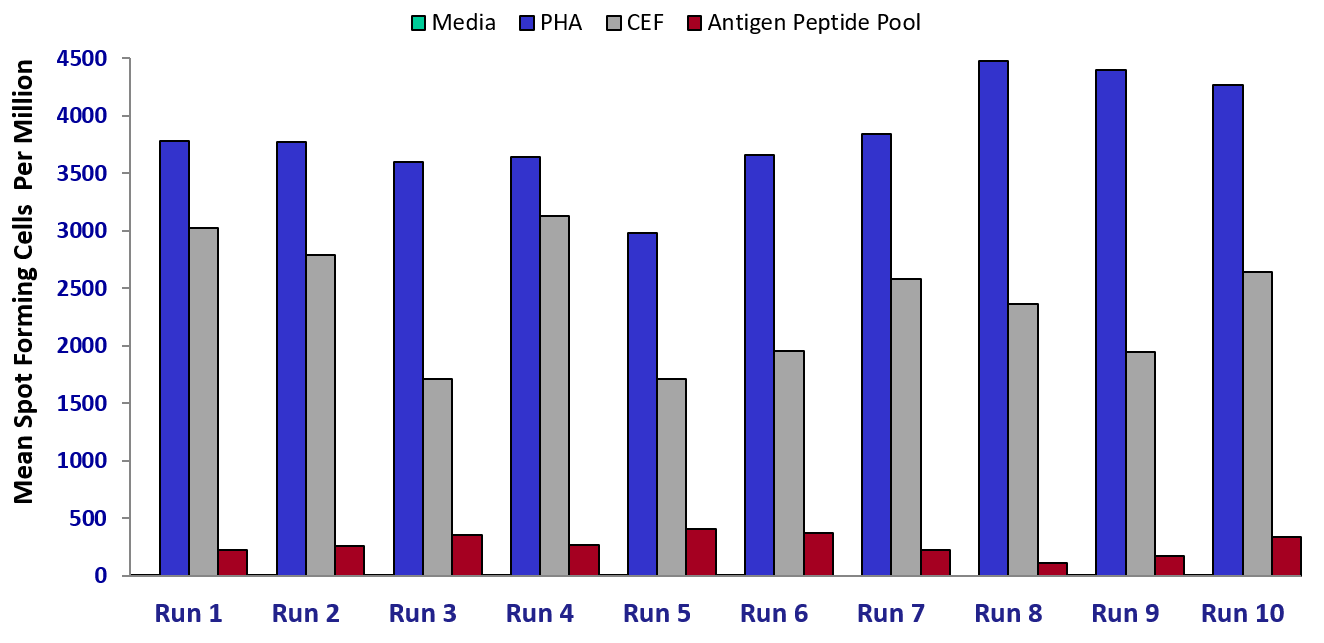
Figure 1. Data from IFN-γ ELISpot assays carried out by ProImmune. A donor with a positive antigen response was first identified and then used for each subsequent ELISpot analysis for the program as a performance control. Consistent responses were seen against the antigen, the ProMix CEF peptide pool and PHA across the 10 ELISpot runs, while the media-only negative control responses remained low.
Mixed Lymphocyte Reaction (MLR)
Assess the small molecule’s impact on immune modulation with the Mixed Lymphocyte Reaction (MLR). T cells from one donor will proliferate in the presence of antigen-presenting cells (APCs) from a different donor due to the HLA mismatch. MLR is often used as a means of inducing generalized stimulation/activation of T cells in culture. As the T cell responses are typically quite strong is this assay, MLRs are excellent tools for evaluating the inhibitory potency of the small molecule, as well as a weakening effect on the T cell response.
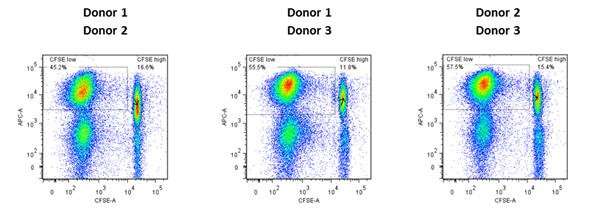
Figure 2. Flow cytometry plots showing gated live lymphocytes proliferating as a consequence of the MLR reaction. In each case monocyte derived dendritic cells (top row of figure title) were co-cultured with T cells from a mismatched donor (bottom row of title).
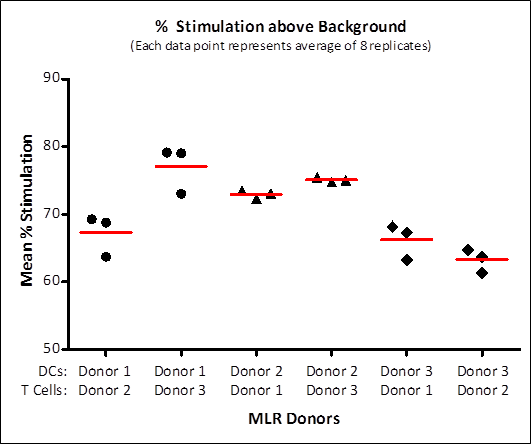
Figure 3. Assays were carried out in three repeat sets. The values for each set (represented by each dot) represents the average of 8 replicate wells each. MLR responses fell between 60-80% captured CD4+ T cells having undergone proliferation for all donors.
ProMap® T Cell Proliferation assay
Certain small-molecule drugs can have direct effects on T cell activation and subsequent proliferation. We use CFSE-labelled PBMCs from healthy individuals in the ProMap® T Cell Proliferation assay to address these questions. PBMCs are typically cultured with small molecules for 7 days to measure CD8+ or CD4+ T cell proliferation in a flow cytometry assay and combined with additional phenotypic markers as required. This assay can also be used to measure the inhibitory or stimulatory properties of the small molecule when cultured in the presence of CEF or CEFT.
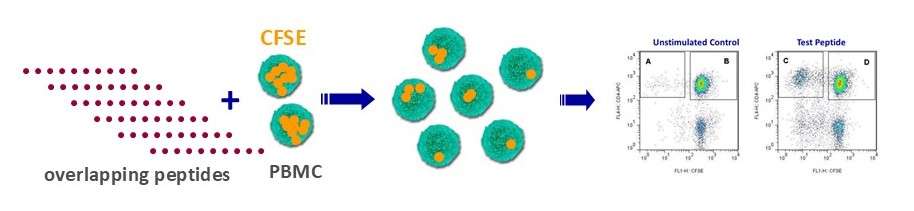
Figure 4. ProMap® naive CFSE T cell proliferation assay outline. Overlapping peptides of interest are co-cultured with PBMCs, then T cell proliferation is measured by CFSE dye-dilution assay in flow cytometry.
ProImmune REVEAL® Competition assay
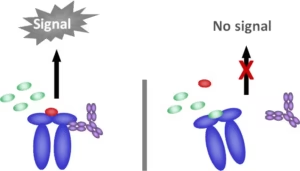
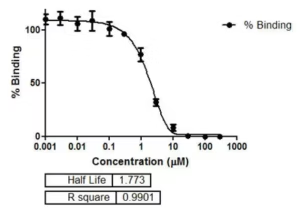
Evaluate the potential for small molecules to directly bind to MHC with the ProImmune REVEAL® Competition assay. Some small molecules can fit in the MHC grove or influence immune signalling by interfering with the MHC-peptide complex. This can be assessed when a recombinant MHC molecule is pre-loaded with a known high-affinity T cell epitope and the small molecule is titrated in. Detection is based on the presence or absence of the native conformation of the MHC-peptide complex and displacement of the labelled T cell epitope control peptide.
 |  |
|---|
Figure 5. a) Competition assay principle: A labelled control peptide is bound to the MHC-complex, giving a high baseline signal in an immunoassay. As the peptide is competed away with unlabelled competitor peptide the signal reduces at increasing concentration of competitor peptide. The control peptide is usually a well known HLA-Class II restricted immunodominant T cell epitope which is further known to be restricted to the HLA-DR supertype of interest. b) Example data for the assay. Half-life is determined using 12 competitor concentrations and single time constant off rate curve.
ProScern® DC-T Proliferation assay
Investigate the small molecule impact on Dendritic cell (DC) presentation with the ProScern® DC-T Proliferation assay. Many small molecules can interfere with DC function through disruption of signalling pathways, resulting in increased or decreased antigen presentation capacity. This can be explored by loading full length immunogenic proteins, such as KLH or tuberculin PPD onto monocyte-derived dendritic cells with and without the small molecule drug present. Following antigen processing, the cells are co-cultured with autologous CFSE-labelled PBMC for 7 days, followed by flow cytometry to analyze CD4+ T cell proliferative responses. The ability of the small molecule to enhance or reduce antigen presentation as measured by functional T cell proliferation can be determined.
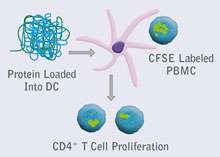
Figure 6. Outline of ProScern® CFSE DC-T Cell Assay. Dendritic cells are loaded with protein antigen of interest, then co-incubated with CFSE-labelled PBMCs. Cumulative T cell proliferation measured after 7 days.
ProPresent® Antigen Presentation assay
Understand the impact that protein modifications can have on the peptide presentation profile with the ProPresent® Antigen Presentation assay. Small molecules that can bind to larger carrier proteins and act to change how that protein is seen by the immune system. To assess this, proteins with and without the small molecule are loaded onto monocyte derived dendritic cells for antigen processing. MHC-peptide complexes presented on the surface of the cells are immunoprecipitated and peptides are eluted for sequencing by mass spectrometry. This approach is widely used and is considered the gold standard for identifying naturally processed and presented peptides
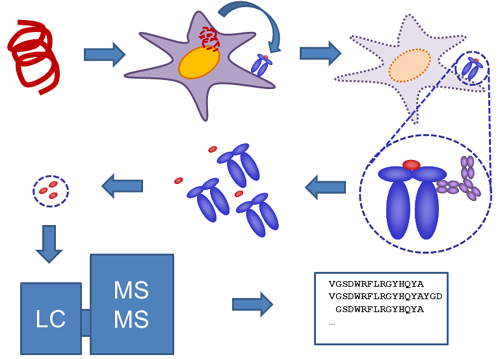
Figure 7. ProPresent® example workflow when measuring presentation from protein or protein mixture. Antigen-presenting cells take up the protein and process/present peptide fragments bound in MHC molecules on the cell surface. Cells are lyzed and HLA-peptide molecules recovered in an immune affinity step. Peptides are recovered from the HLA molecules and analyzed by LC-MS/MS. Identified sequences are subjected to rigorous analysis to identify true positive peptides with high confidence.
ProStorm® Cytokine Release Assay
Some small-molecule drugs, such as STING pathway agonists, have been associated with cytokine release syndrome. The drugs can trigger innate signalling pathways that result in inflammatory cytokine release and ultimately, cytokine related toxicity. To measure the impact of small molecules on the production of innate-mediated cytokines, the ProStorm® Cytokine Release Assay can be used. The small molecules are added at a range of concentrations to fresh, whole-blood in an overnight assay and a panel of key immune mediators, such as IL-6, IL-8 and TNF-alpha are quantified.
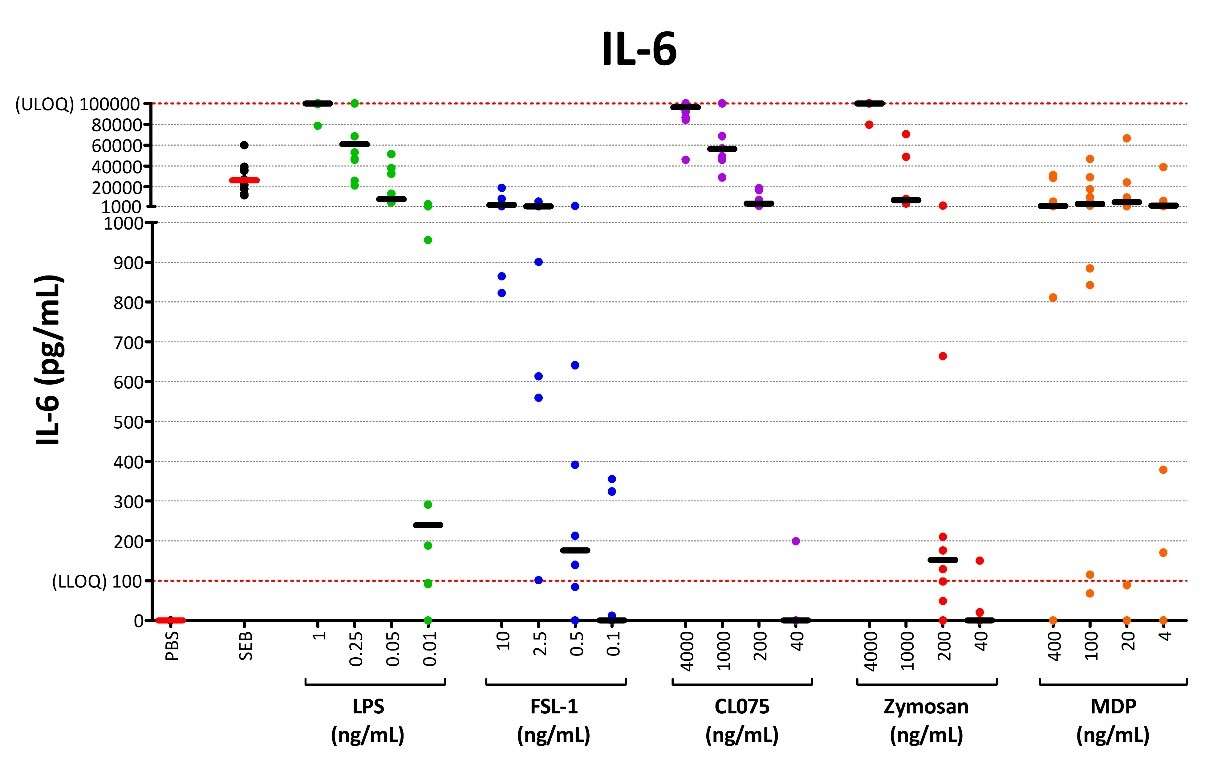
Figure 8. Cytokine Response Data for IL-6. Responses from a cohort of 29 donors, stimulated with (left to right) LPS, FSL-1, CL075, Zymosan, and MDP, at a range of concentrations. Medians are indicated by black lines.
Examples of Immune Modulation Studies for Small Molecules
There are a number of complex mechanisms in which small molecules can have a negative impact on the immune system. With demonstrated success in providing solutions for evaluating biologics and other modalities, ProImmune’s expertise and integrated platforms can help you to understand the immunogenic potential of your small molecule drug. We’ve worked with large pharma and biotech companies to help find solutions to their small-molecule drug questions, such as;
- Quantify stimulatory capacity of multiple small-molecule drugs on HBV-specific immune responses in HBV infected individuals in ELISpot and MLR.
- Determine the impact of 7 small-molecules candidates on memory CEFT responses in ELISpot and ProMap T cell proliferation assay.
- Evaluate whether a small-molecule drug lead candidate enhances HIV-specific immune responses in HIV infected individuals in an ELISpot.
- Explore a small molecule lead compound’s effect on CEFT memory responses at a range of concentrations as measured by an IFN-γ ELISpot.
If you would like copies of sample reports for any of the assays described or would like to discuss the technical details of your own project requirements in a confidential manner and receive a costed proposal, please don’t hesitate to contact our team of immunology specialists who will be delighted to assist you.